
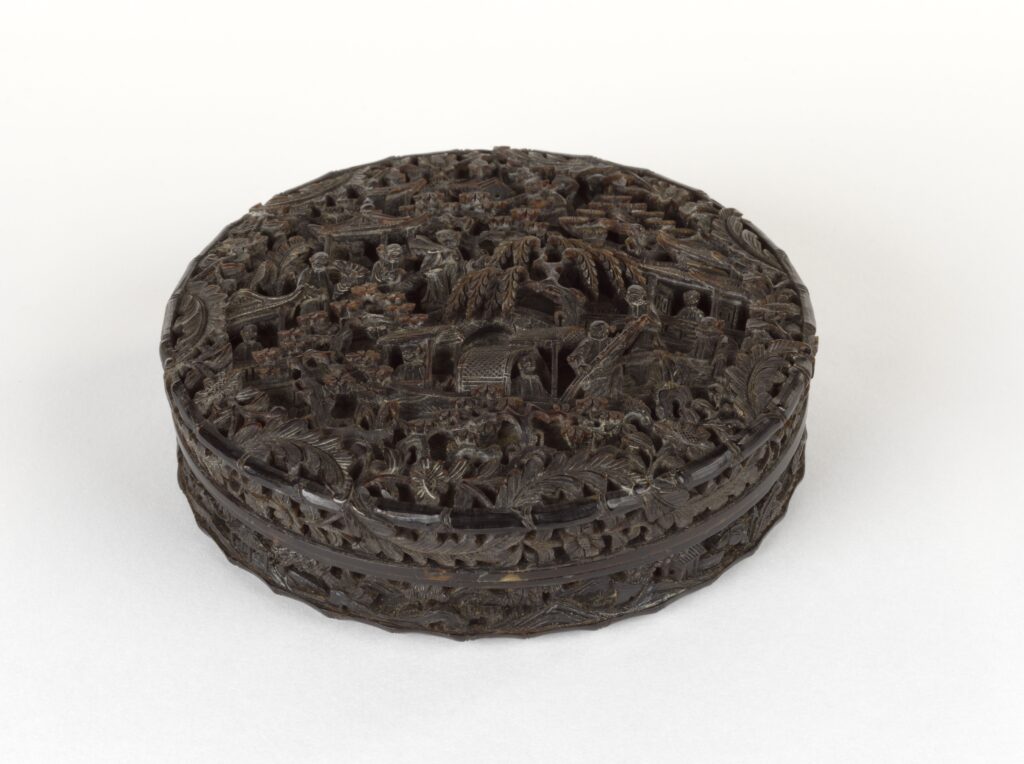
Carved Snuff Box
BELUM.C33.1911
© Image courtesy of National Museums NI
BELUM.C33.1911: Traditional Chinese Snuff Box
Material: Tortoise Shell | Culture: Chinese | Location Collected: China
Tortoise shell snuff box with carved decoration in relief with figures, trees, plant life, boats, pagodas, and islands. The use of narrative landscapes on small luxury objects embodied an educated ideal, where portable objects like snuff boxes became vehicles for aesthetic appreciation and social distinction. Snuff is a finely ground or shredded tobacco inhaled through the nose or rubbed on the gums. It was introduced to China by Europeans and at that point was believed to have healing powers. It became fashionable and a status symbol in later years. Probably produced for export market in the 19th century. A snuff box such as this would be very prized among both the Chinese elites and European collectors, reflecting the cross-cultural appeal of Chinese decorative arts during the height of the Canton export trade. Qing dynasty.
"From a tribute of the Qing Dynasty imperial court to a timeless treasure, this tortoise shell round box holds the code of cultural integration between China and the West from a century ago. Its elaborate and exquisite full-relief carving technique is not only a concrete embodiment of the pinnacle craftsmanship of Qing Dynasty artisans, but also a precious witness to the collision and mutual learning of Eastern and Western aesthetics."
Wei Deng, Project Participant
Take the 3D Tour

Jade Buckle
BELUM.C265.1949
© Image courtesy of National Museums NI
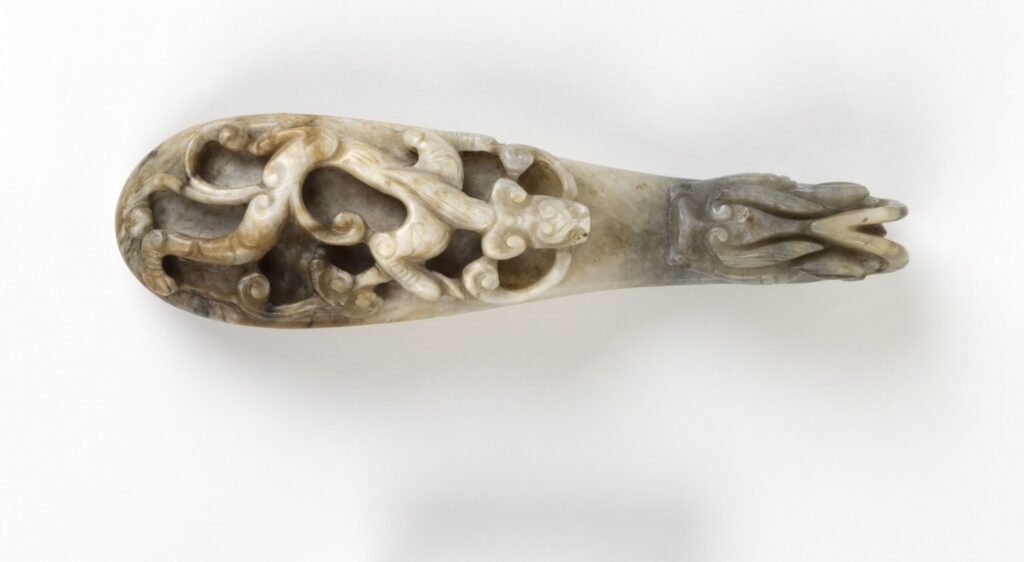
BELUM.C265.1949: Jade belt buckle depicting dragon motifs
Material: Jade | Culture: Chinese | Place of Collection: China
Grey jade carved ornament based on archaic belt hook design. It has a hook or protrusion on the back to attach a belt. Dragon motifs on the design. The hooked section depicts a mature dragon (long) and the relief on the shaft a ‘baby’ dragon (chi long), symbolising good fortune.
“What I like is how the two dragons seem connected, almost like one growing out of the other. It feels protective, as if the object is carrying a wish for strength and good fortune across generations.”
Sharon Fan, Project Participant
Take the 3D Tour
Horsehead Tobacco Pipe
BELUM.C5887
© Image courtesy of National Museums NI
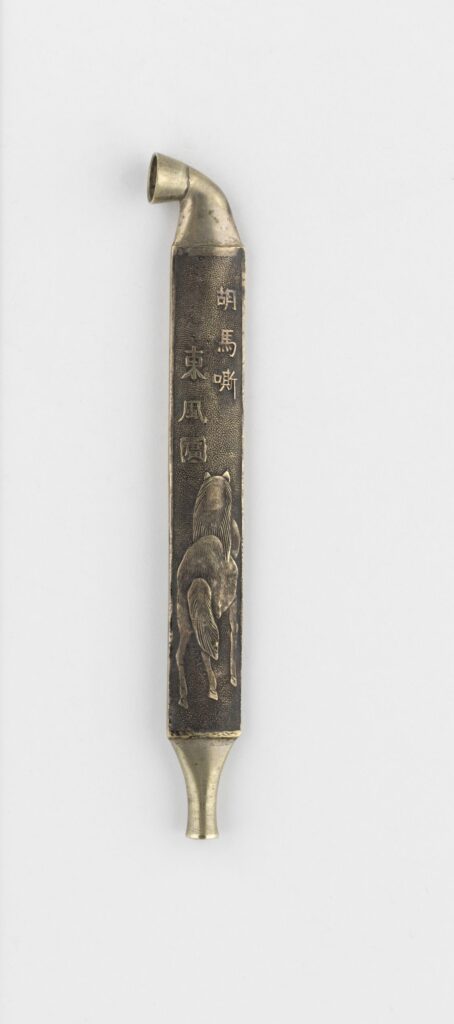
BELUM.C5887: Traditional Chinese Tobacco Pipe
"The structure of the final character resembles the character 廣 (simplified 广, guǎng, meaning “broad,” “wide,” or “vast”) enclosed within 囗 (wéi), which denotes an enclosing border. At first glance, this combination does not appear to relate directly to the meaning of 'east wind'. However, it is possible that 囗 functions purely as a framing or enclosing element, rather than contributing semantic meaning. In that case, the inner component may represent a name, brand, or maker’s mark, rather than a standard character used for its lexical meaning."Liang Wang, Queen's University Belfast
I feel such a powerful connection to this little ‘horse-head tobacco pipe'. Every word engraved on it seems to speak directly to me. I can almost picture a soldier alone in a remote, frozen wilderness, sitting atop his horse exhaling puffs of smoke into the night — while his heart overflows with an intense longing for home. I have left Hong Kong now for 35 years. I missed my Dad’s funeral - separated from my love ones by thousands of miles, the regrets and ache are something only my own heart could truly feel.Sally Gillespie, Project Participant
Take the 3D Tour
Lotus Shoes
BELUM.C5037
© Image courtesy of National Museums NI
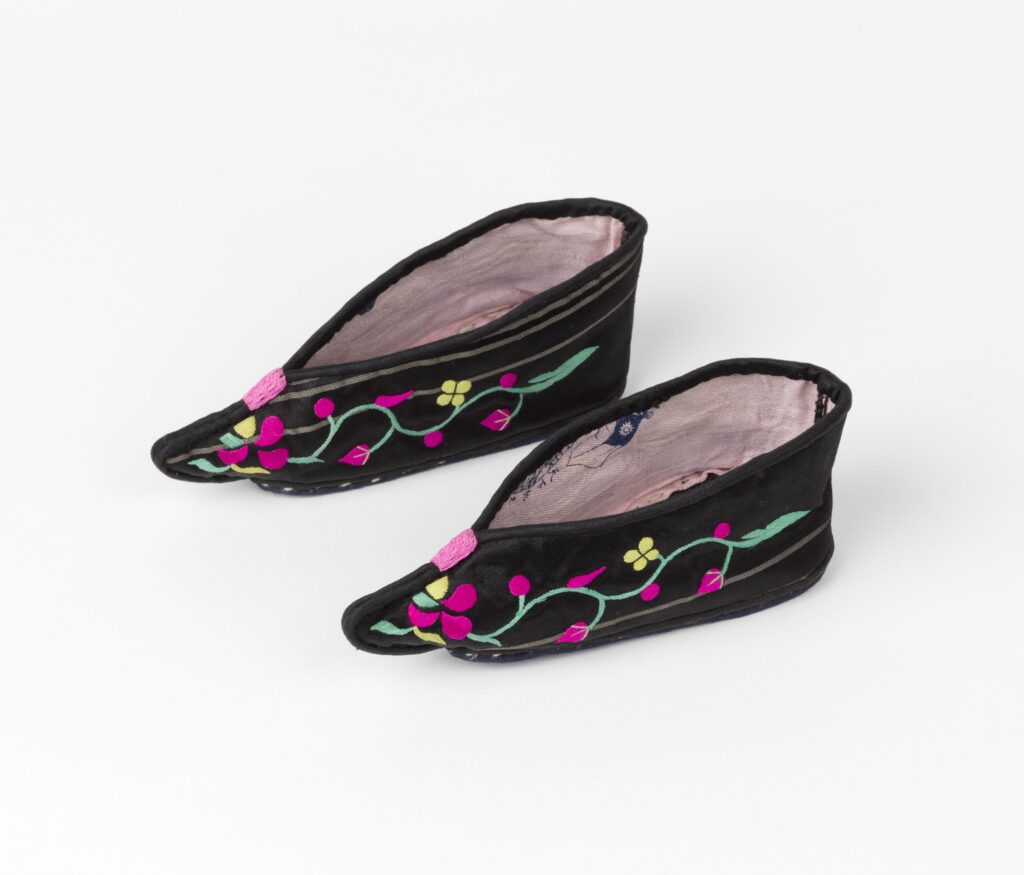
BELUM.C5037: Shoes
Length: 15cm | Material: Silk | Culture: Chinese
Shoes for bound feet, gong xie (弓鞋). Small pair of black silk shoes for bound feet with bright pink, yellow and green embroidery of plants. The lining of the shoes indicate they were commercially made in the early 20th century, a time when foot binding was beginning to become controversial in China. Small feet on women were a sign of beauty in China for centuries, with 3 inches being considered an ideal beauty. The practice in which the feet of girls were bound started at an early age to keep them small and pointed is no longer carried out in China. It causes much damage and pain to the women involved. The lotus flower shoes were for bound feet, and they speak to the social boundaries between the Chinese Han majority and the Manchu women, who were forbidden to bound their feet, and so they adopted the platform shoes. Foot binding was banned in China in 1912, and the practice completely died out in the mid-twentieth century.
"This object brought back memories of my grandmother – a woman I had always admired, growing up believing that she had somehow resisted foot binding in her youth. Through the conversations and research prompted by the Bridges to China project, I began to understand that her story was shaped not only by personal strength, but by the social and economic realities of that time in Chinese history. Being part of this project allowed me to see a cherished childhood memory in its fuller historical context. Rather than diminishing her, that understanding deepened my respect for her life and helped me recognise my own connection to that inheritance."
Connie Tang, Project Participant
Take the 3D Tour