
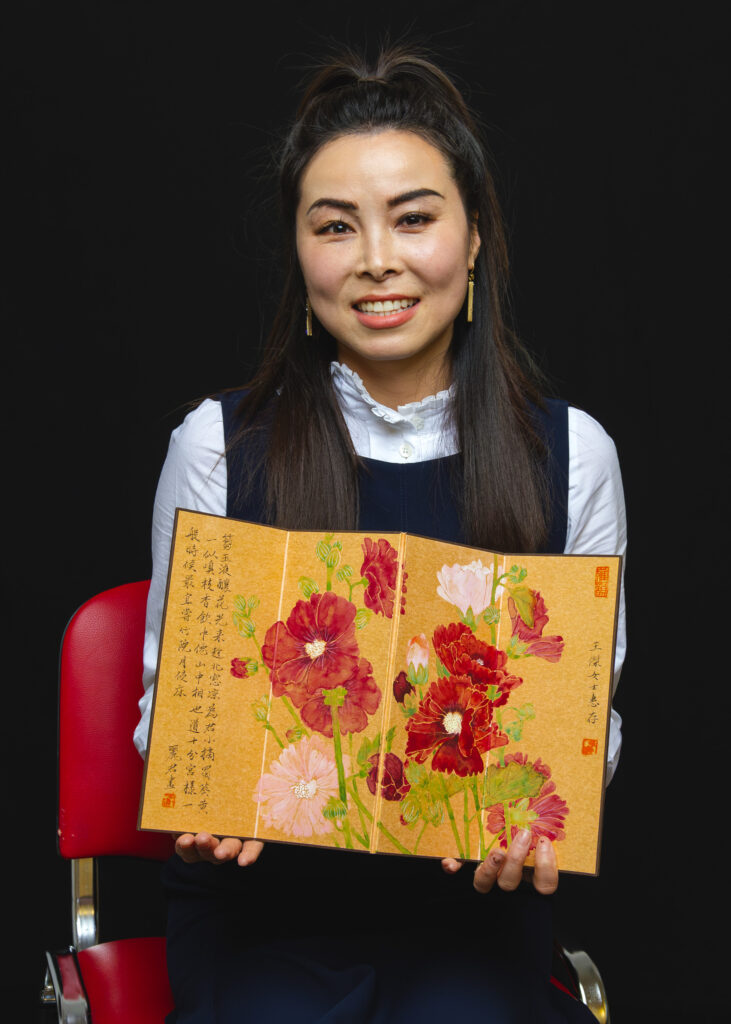
Meet Kelly Wang
Project Participant
Through the Bridges to China project, Kelly shares her personal connection to Chinese cultural artifacts and the deep meanings they carry. Her story explores the traditions of ancient Chinese scholars and the symbolic importance of art in Chinese culture.
Kelly’s narrative offers insight into how cultural objects serve as bridges between past and present, and between different communities in Northern Ireland.
Watch Kelly’s Story
Video also available on Panopto
The Sleeve Treasure: A Cultural Gift
This Chinese folding painting was a house-warming gift from my friend Winnie. It functions almost like a miniature room divider. On the left side, there is a poem written in traditional Chinese calligraphy, while the rest of the painting is filled with delicate floral motifs.
The poem is written vertically and read from right to left. It tells the story of someone receiving a bottle of autumn wine from a friend. He leans by the window, enjoying the cool air and autumn scenery, and reflects that the best time to drink the wine is right now — with friends, in a quiet courtyard where bamboo shadows sway and moonlight spills across the room. At its heart, the poem is about friendship and cherishing the present moment.
You may notice there is no punctuation in the poem. In classical Chinese poetry, this is common. The rhythm and rhyme carry the meaning. The absence of punctuation leaves space for interpretation and gives the writing a natural, flowing quality.
Practising calligraphy as a child, however, was a nightmare for me. My mum was a Chinese teacher and would never tolerate messy handwriting. I remember having to fill four or five full pages just to perfect a single stroke. She could always tell whether I had written with care. Sometimes she would look at a page and say, “I don’t like this one — there’s no strength in it.” She believed that temperament reveals itself in brushwork — the way you finish a stroke can show whether you are calm or impatient. She often said that practising calligraphy shapes your character, that it tempers and disciplines you.
There is another story connected to this painting. A friend of mine received a similar piece from Winnie. The artist accidentally left out one word — 危, meaning “danger” — and later squeezed it back in quite obviously. My friend was unhappy about it, as she associated the word with a bad omen for her new home. In Chinese gift-giving culture, symbolism and auspicious meaning matter deeply. People pay close attention to words and imagery, especially for significant occasions such as moving house.
Working on this project gave me the opportunity to present this painting and reflect on Chinese gift-giving traditions — on how we express care and friendship through meaningful objects. It also brought back memories of my childhood. Whenever I see beautiful calligraphy now, I still feel a small sense of regret that I did not practise more seriously when I was young.