

Meet Yushan (Connie) Tang
Researcher
Yushan Tang moved from China to Northern Ireland in 2009. As a business founder and psychology researcher, living between cultures has shaped her deep interest in how memory, identity and objects are connected through lived experience.
Taking part in Bridges to China has given her the opportunity to reflect on her own journey while reconnecting with shared cultural roots. She values how heritage programmes like this contribute to a more open, inclusive and vibrant cultural landscape in Northern Ireland.
Watch Connie’s Story
Video also available on Panopto
Lotus Shoes
Bow Shoes (弓鞋): Gender, Craft, and the Bound Female Body in Chinese History
Introduction: What Are Bow Shoes?
Bow shoes, also widely known as lotus shoes, are small, delicately made shoes designed for women whose feet had been bound through the traditional Chinese practice of foot binding (chánzú 缠足). These shoes are closely associated with the ideal of the “three-inch golden lotus” (三寸金莲), a term that came to represent the culturally constructed ideal of feminine beauty in late imperial China.
Although visually striking for their size and ornamentation, bow shoes are inseparable from the bodily discipline that produced them. They functioned not merely as footwear, but as material evidence of gendered norms, social hierarchy, and the regulation of women’s mobility over nearly a millennium of Chinese history.
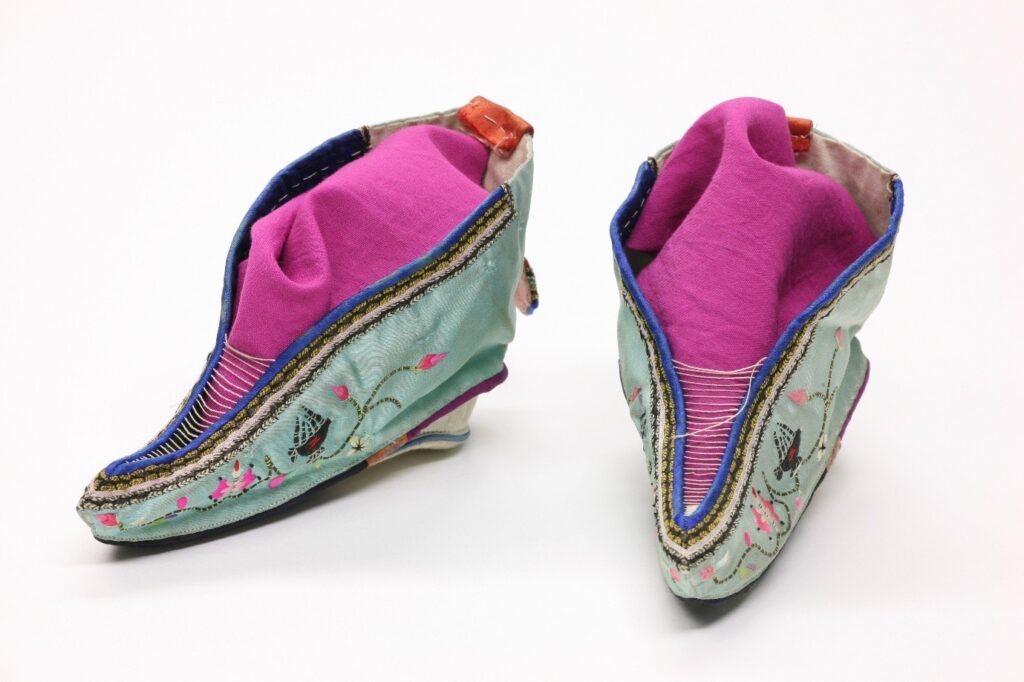
Image 1: Pair of bow / lotus shoes
Image credit: Wikimedia Commons
Source: Wikipedia, Lotus shoes
Historical Origins of Foot Binding and Lotus Shoes
Foot binding is generally understood to have originated during the Five Dynasties and Ten Kingdoms period (10th century) and became widespread during the Song dynasty (960–1279). Early literary accounts describe court dancers performing on bound feet, contributing to the association between small feet, elegance, and elite femininity.
By the Ming (1368–1644) and Qing (1644–1912) dynasties, foot binding had spread far beyond court culture. While it initially marked elite status, the practice later extended across social classes and regions, though with significant variation. Correspondingly, lotus shoes became a common feature of women’s material culture, adapted to regional tastes, economic conditions, and available craftsmanship.
Importantly, the most extreme form of foot binding—the tightly arched “three-inch lotus”—appears to have developed relatively late, around the 16th century, suggesting that both the practice and the shoes evolved over time rather than remaining static traditions.
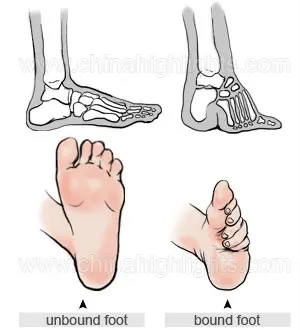
Image 2: Chinese foot binding
Source: China Highlights, “8 FAQs about Foot Binding”
Craftsmanship and Materials: Reading the Shoe as an Object
Lotus shoes were typically handmade, often by women themselves or by female relatives. Traditional examples feature hand embroidery using silk threads, with motifs symbolising fertility, longevity, or marital harmony.
However, some surviving bow shoes display a hybrid construction: machine-embroidered uppers combined with hand-stitched soles. The presence of industrial workshop stamps on the inner lining of certain shoes indicates production during a transitional historical moment—likely the late Qing or early Republican period, when early industrialisation and mechanised workshops began to coexist with domestic handcraft traditions.
Such objects reflect not only personal use but also broader transformations in Chinese society, including the influence of the first Industrial Revolution and the emergence of early commercial enterprises.
Social Meaning: Gender, Status, and the Female Body
In late imperial China, bound feet were widely regarded as markers of beauty, refinement, and moral respectability. Small feet were believed to enhance a woman’s desirability and marriage prospects, and in some regions, foot binding functioned as a form of social capital for families seeking upward mobility.
At the same time, foot binding severely restricted women’s physical mobility and reinforced their confinement to domestic space. Bow shoes therefore embodied a paradox: they were admired for their aesthetic delicacy while simultaneously symbolising physical pain, long-term disability, and gendered control.
Scholars have debated whether foot binding should be understood primarily as male oppression, a Confucian moral discipline, or a practice maintained and transmitted by women themselves. Contemporary historical research emphasises that mothers often made pragmatic decisions to bind their daughters’ feet in response to economic realities and social expectations, particularly in households reliant on indoor textile labour.
Decline and Abolition
From the mid-19th century, foot binding increasingly came under criticism. Reform-minded intellectuals, Christian missionaries, women’s organisations, and revolutionary movements such as the Taiping Rebellion all contributed to growing opposition. Anti-foot binding societies emerged in urban centres, advocating for “natural feet” (tiānzú 天足).
In 1912, following the fall of the Qing dynasty, the new Republican government officially outlawed foot binding. Although enforcement was uneven—particularly in rural areas—the practice declined rapidly over the following decades. By the mid-20th century, foot binding had virtually disappeared, and the last lotus shoe factory in China closed in 1999.
Interpreting Bow Shoes Today
Today, bow shoes are preserved in museum collections as powerful historical artefacts. They invite reflection on how beauty standards, gender norms, and bodily discipline were culturally constructed and sustained over centuries.
For contemporary audiences, these shoes do not speak with a single voice. They evoke pain and restriction, but also skill, endurance, and the lived experiences of women whose stories were rarely recorded in written history. As objects, bow shoes allow us to move beyond abstract narratives and engage directly with the material realities of women’s lives in pre-modern China.
Sources
This article has been written using a synthesis of established historical and scholarly resources to support public understanding of bow shoes (弓鞋), also known as lotus shoes, and the wider practice of foot binding in China.
The principal reference sources include:
- Wikipedia, “Foot binding”
Used for historical overview, chronology, regional variation, social interpretation, and summaries of academic scholarship on foot binding and lotus shoes. - China Highlights, “8 FAQs about Foot Binding”
Used for general explanations, terminology (including gong xie 弓鞋 / arch shoes), and accessible descriptions intended for a public audience.
These sources themselves draw on a wide body of academic research by historians and scholars of Chinese women’s history, including Dorothy Ko, John R. Shepherd, Laurel Bossen, and Hill Gates.