
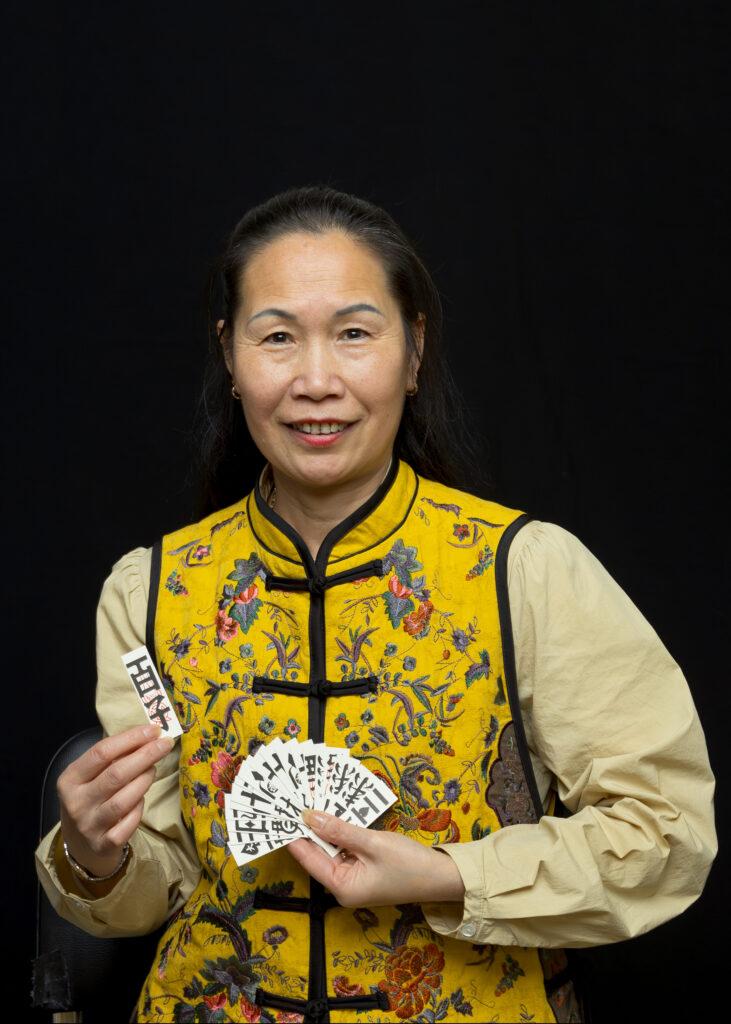
Meet Rebecca (Fenglian) Zhang
Fenglian Zhang, originally from Guangzhou, China, has been living in Northern Ireland for the past 19 years. Since retiring, she has been actively involved in community service and currently serves as Vice-Chairperson of the Oi Kwan Women’s Group. Her main focus is volunteering and supporting the Chinese community in Belfast.
Through the project, she shared the story of traditional Hakka playing cards. Although simple in form, these cards bring daily joy and companionship to many elderly members of the Chinese community in Northern Ireland, demonstrating how small objects can carry deep social and cultural meaning.
“Since moving to Hong Ling Garden, a social housing community for elderly Chinese residents, four years ago, I have met many Chinese people living there. Most of them are retired, and retirement is not always easy. Many of us, including myself, do not speak English well. After losing the ability to work and the sense of identity that comes with employment, life can feel even more challenging.
As a result, many residents play Hakka card games for entertainment. Four or five people gather each day to play, chatting and gossiping as a way to pass the time. Sometimes they even argue over who has won or lost. When I watch from the side, I often feel helpless, and sometimes a little saddened. What I see is only a small glimpse of the loneliness and neglect that many elderly people face.”
Hakka Playing Cards
Hakka cards, also known as Six Tiger Cards or Leaf Cards, are a traditional Chinese card game originating from the Ming Dynasty. The gameplay combines elements of both mahjong and playing cards.
The deck is characterised by the suits “Wan” (characters), “So” (bamboo) and “Tong” (circles), along with special cards similar to “Zhong”, “Fa”, “Bai” and “Mo Tou”. A standard set usually consists of 120 cards. The designs are generally simple, sometimes featuring printed patterns.
How the Game Is Played
-
Each player is dealt 15 cards, while the dealer receives 16.
-
The objective is to form combinations similar to those in mahjong, such as pairs and sets.
-
Players may “touch” cards but cannot discard immediately after doing so.
-
Priority is given to the player closest to completing a winning hand.
-
Winning (Hu) can be achieved either by self-draw or by claiming another player’s discard.
-
A minimum scoring requirement, often six points, is typically needed to declare a winning hand.
Cultural Significance
Hakka cards reflect the simple, communal lifestyle of Hakka people and serve as a popular form of social entertainment in their spare time. The game is lively and engaging, and it remains commonly played in Hakka villages and public parks.