

Emily Cong
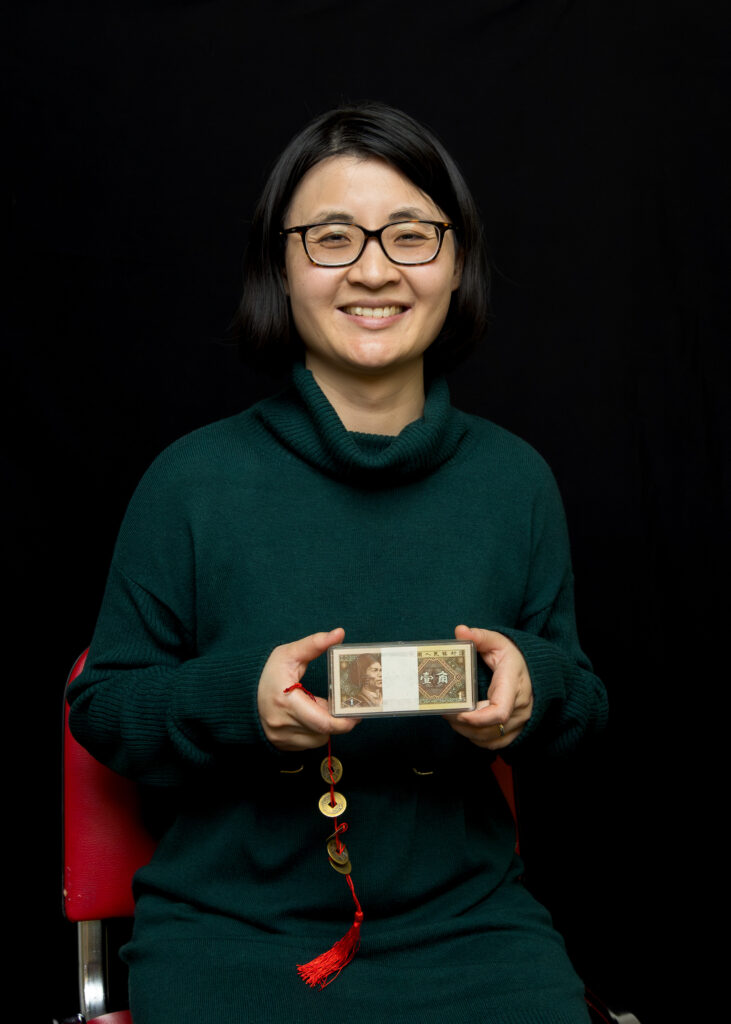
Meet Emily Cong
Chartered Accountant
Emily Cong is a chartered accountant who has lived in the UK for over fifteen years, eight of which have been spent in Belfast.
Through Bridges to China, Emily shares her personal connection to Chinese objects in the Ulster Museum, alongside a set of yi jiao RMB notes she received from her grandmother. Her stories centre on family values and intergenerational relationships in Chinese culture. For Emily, love and memory span generations, serving as a bridge between past and present, and between Chinese and Ulster cultures.
Watch Emily's Story
https://youtu.be/7sgBVVDp31k
Video also available on Panopto
The Timer, the Bodhisattva and RMB
I have been in the UK for over fifteen years, and I have lived in Belfast for eight of those years. Belfast has truly become my home. Going back to China each year has turned into a long haul journey. Rushing through airports, catching flights, being picked up and seen off by my parents—between departures and arrivals, time always feels both the most precious and the shortest. That’s why when I saw the Sundial in the Ulster museum, it reminded me about rushing through the airports and counting the hours for the flight journey every time I go back to China.
Every year, I’m really looking forward to going back to China to reunion with family and friends. I was born in late 1980s. When I was young, the country was developing at a high speed, and people found opportunities almost everywhere. In my memories, my parents were always very busy, so I spent a large part of my childhood with my grandparents. The most delicious dishes in my memory are the noodles my grandma外婆 made and the mixed vegetables cooked by my other grandma奶奶. My grandma believes in Buddhism and there was always a statue of Guanyin at home. My grandma would worship the Buddha on all important festivals and events. This is why when I saw the Buddha in the Ulster museum, although it’s different because it’s Sino-Tibetan style, but it still looked very familiar.
My grandma likes to collect coins and paper money. I remember visiting her home during Chinese New Year when I was little—she would always slip some pocket money to her grandchildren. This set of yi-jiao RMB notes was something she specially collected and gave to me, because it was issued and put into circulation in the year I was born. Not just for me—my grandma remembered the birthday of every single grandchild, so everyone received something specially chosen from her collection. Most of her collection consisted of coins that were not worth much monetarily, but held great sentimental value. It was much like everything she did for her children and grandchildren—given on ordinary days, through small things, day by day, year after year. Yet these are the most beautiful parts of our childhood memories.
Thank you to Bridges to China project for giving me the opportunity to reflect on my connections with my families in China and to write something in gratitude and in remembrance of my grandma.

Sylvia Yue & Sau Ling Li
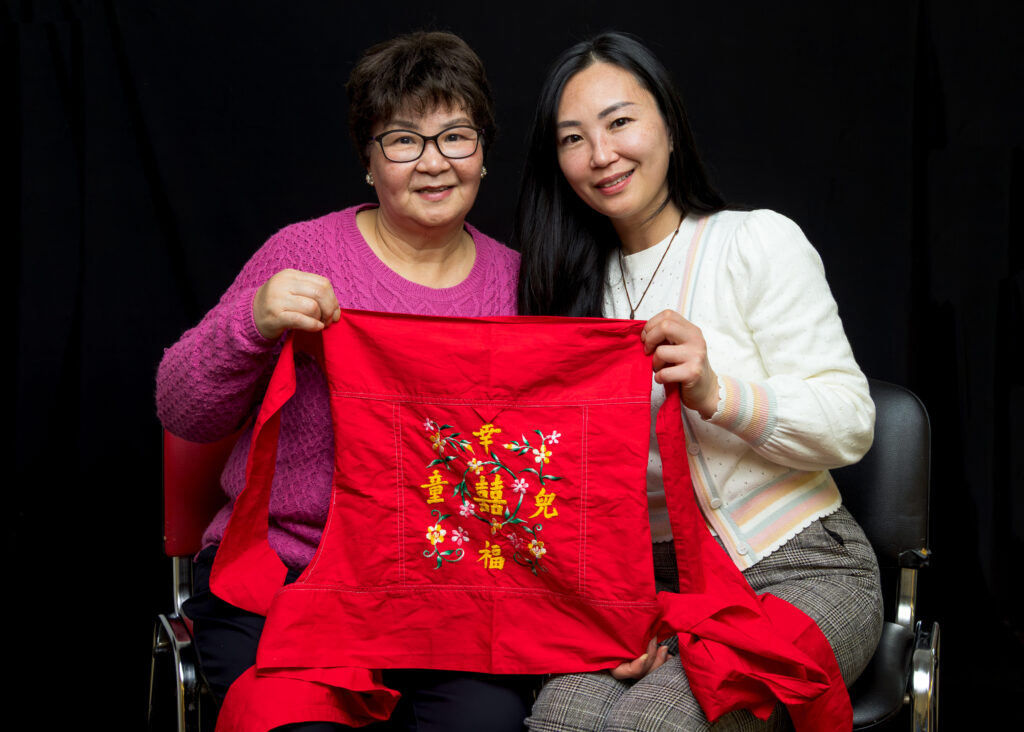
Meet Sylvia & Sau Ling
Teacher
Sylvia Yue’s contribution to Bridges to China centres on a traditional Chinese baby sling used by her mother when she was an infant. Embroidered with Chinese characters meaning 'happy child' or 'blessed child', the sling carries her parents’ hopes and wishes for her life. Passed down through generations and later used to carry Sylvia’s own son, the object reflects themes of care, continuity and the transmission of love and blessings within family life.
She also has a really cool Mum, Sau Ling Li.
Watch Sylvia's Story
https://youtu.be/3S8CkoNh3gc
Video also available on Panopto
Mumories
Mum
I remember using this baby sling to carry my daughter on my back until she was about two years old. It was a gift from my mother-in-law and it quickly became part of my daily life. The sling was practical and comfortable and it reflected traditional Chinese wisdom, allowing me to keep my daughter safe and close while still freeing my hands for housework.
I kept the sling for many years and later passed it on when my grandson was born in Northern Ireland. For me, it carries my love and blessings for my family. I hope it can continue to be passed down, connecting generations through care, memory and affection.
Daughter
I remember being told that this was the baby sling my mum used to carry me when I was a baby. Even though I don’t remember that time myself, the sling has always felt connected to my earliest years and to the care my parents gave me. Knowing that I was carried so close to my mum makes the object feel very personal and reassuring.
The embroidered Chinese characters on the sling read 幸福兒童, meaning “happy child” or “blessed child”. My parents explained that these words carried their wishes for me to grow up with love, joy and good fortune. When I look at the sling now, I think about those hopes and about how they were woven into everyday family life, not spoken loudly but held quietly through objects like this.
Ri Fang Hao
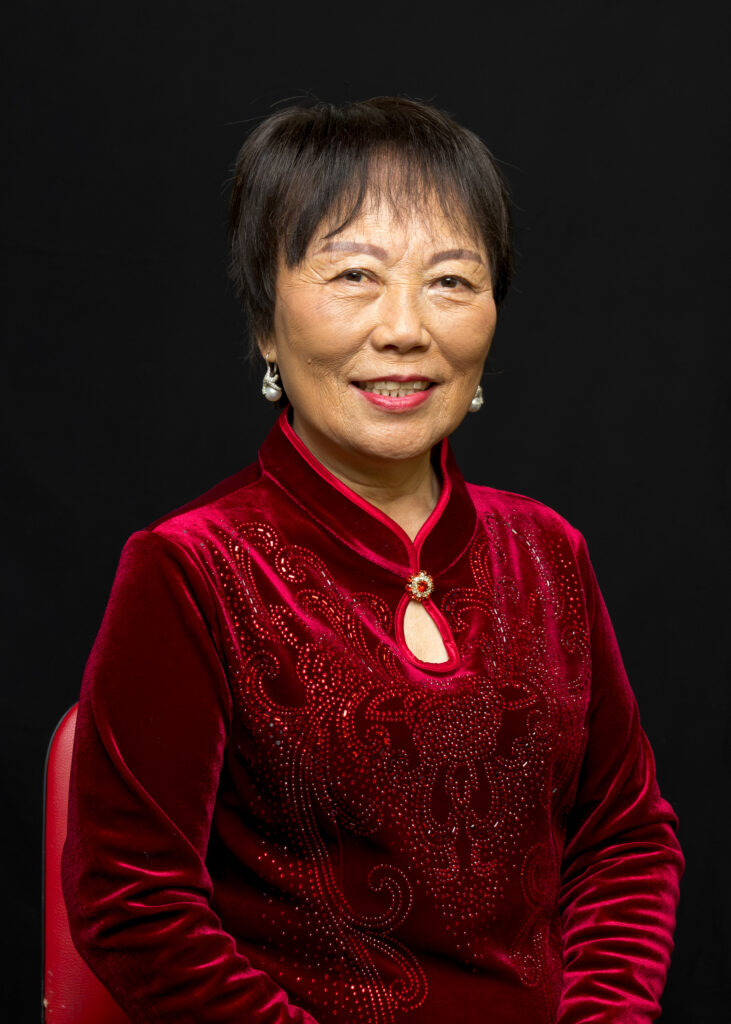
Meet Dr. Ri Fang Hao
Doctor, Traditional Chinese Medicine
Dr. Ri Fang Hao’s contribution explores the deep cultural, historical and symbolic significance of the Chinese guardian stone lion. Drawing on mythology, Buddhism, folklore and architectural tradition, she reflects on how these sculptural figures have evolved from exotic symbols introduced through the Silk Road into powerful guardians of homes, institutions and communities. Through these objects, Ri Fang Hao highlights the enduring role of guardian lions as protectors, status markers and carriers of collective memory within Chinese culture.
Dr. Hao first specialised in Traditional Chinese Medicine, traversing the wild hinterlands of Inner Mongolia and providing much needed treatment to many of China's underserved minority ethnic communities. She then became qualified in Western medicine, travelling to places as far as Poland in the development of her career before coming to call Northern Ireland home, where she opened and has run her own practice in Belfast for nearly 30 years.
Watch Ri Fang's Story
https://youtu.be/t5nuuoluLdg
Video also available on Panopto
Guard Lions > Guard Dogs
Chinese Guardian Lions
The imagery and legends of the Chinese guardian stone lions form a rich and profound subject within Chinese culture. Below is a detailed explanation covering their characteristics, historical origins, legends, cultural symbolism and traditional placement rules.
The Classic Image of the Stone Lions
Guardian stone lions usually appear in pairs, one male and one female, standing on either side of a main gate. Their form is not a realistic depiction of an actual lion but a mythical creature shaped through artistic exaggeration and symbolism.
1. Distinguishing the Male and Female Lions
Male Lion
(usually placed on the right side of the gate when viewed from inside looking out)
-
Paw on an embroidered ball: Symbolises mastery of the universe, unification of the land, power and authority, as if the world is held within the palm of the hand.
-
Expression: Typically majestic and fierce, with an open mouth showing its teeth.
Female Lion
(usually placed on the left side of the gate when viewed from inside looking out)
-
Paw on a cub: Symbolises prosperity, descendants and the continuation of the family line, representing care and inheritance.
-
Expression: Relatively gentle, with a closed or slightly open mouth.
2. Common Visual Elements
-
Mane: The head is decorated with spiral, knot-like curls. According to legend, the number of curls indicates the owner’s official rank. In ancient times, the stone lions in front of a top-ranking official’s residence had thirteen curls, known as the “Thirteen Guardians”. The number decreased by one with each lower rank, and officials below the seventh rank were not permitted to have them.
-
Open and closed mouths: One theory suggests this symbolises “exhaling and inhaling”, with the male lion opening its mouth to draw in wealth and good fortune, while the female lion closes hers to guard and preserve it. Another theory links this to the Buddhist Sanskrit sounds “Ah” and “Hum”, representing the beginning and end of all things.
-
Neck bells and decorative tassels (yingluo): These ornate decorations enhance the lions’ sense of grandeur and sacredness.
-
Squatting posture: The lions are usually shown squatting, with front legs straight and hind legs curled, giving an impression of stability, vigilance and readiness.
II. Historical Origin and Evolution
Lions are not native to China. Their image was introduced primarily through the opening of the Silk Road, arriving as exotic tribute from regions such as Persia and India.
-
Han Dynasty
With the opening of the Silk Road, lions were brought to the Central Plains as tribute. They were known as Suanni and were regarded as one of the nine sons of the dragon, believed to enjoy smoke and fire. As a result, they were often depicted on incense burners. At this stage, their image retained a strong mythological character. -
Tang and Song Dynasties
The lion gradually became a more secular symbol. Stone lions began appearing in tomb carvings, such as the guardian lions at the Qianling Mausoleum of Emperor Gaozong of Tang. Their style was powerful and majestic, serving both protective functions and the display of imperial authority. -
Yuan, Ming and Qing Dynasties
Stone lions became widely used in front of palaces, temples, government offices and the homes of wealthy families, forming a fixed custom of “guarding the gate”. Their design became increasingly standardised, decorative and infused with auspicious symbolism.
III. Related Legends and Stories
The sacred status of stone lions is closely linked to folk legends and Buddhist influence.
-
Protective sacred beast in Buddhism
In Buddhism, the lion is the mount of Manjushri Bodhisattva, symbolising wisdom and strength. The Buddha’s teachings are known as the “Lion’s Roar”, capable of subduing all evil spirits. Stone lions thus inherited their role as protectors and warders of evil. -
Legends of auspicious and divine beasts
-
Some legends claim lions can foresee disasters. In regions such as Sichuan, stories tell of stone lions’ eyes turning red or bleeding before floods, warning people to take refuge.
-
The image of the lion sometimes blends with that of the Qilin, both regarded as mythical creatures that bring good fortune.
-
-
Folk beliefs and fertility legends
In some traditions, stone lions are believed to grant children. Touching the cub beneath the female lion’s paw is thought to bring blessings of offspring. -
The legend of Lu Ban
Some stories attribute the creation of stone lions to Lu Ban, the master craftsman, who is said to have carved them to protect villages and drive away harmful creatures.
IV. Cultural Symbolism and Meaning
Guardian stone lions carry rich cultural meanings, including:
-
Warding off evil and welcoming good fortune: As the king of beasts, the lion’s fierce form is believed to repel evil spirits and protect households.
-
Foretelling disaster and fortune: They are seen as spiritual beings capable of sensing floods, earthquakes and other calamities.
-
Displaying power and prestige: Their size, form and number of mane curls historically reflected social rank and authority.
-
Artistic and architectural decoration: As finely carved sculptures, they lend solemnity and grandeur to buildings.
V. Placement Rules and Taboos
Traditional placement of stone lions follows strict conventions:
-
Always in pairs: Male on the left and female on the right, viewed from inside looking out, reflecting Yin–Yang philosophy and the principle of “male-left, female-right”.
-
Heads facing outward: The lions must face away from the building to guard against external threats. Facing inward is considered inauspicious.
-
Order of placement: The male lion should be placed first, followed by the female.
-
Resolving negative energy (Sha): In Feng Shui, stone lions are used to counter negative influences such as T-junctions, utility poles or sharp corners facing an entrance.
-
Respectful treatment: Traditionally, stone lions should not be touched casually, particularly those in front of government buildings, as they symbolise law and authority.
Modern Application
Today, stone lions have transcended their association with feudal hierarchy and become enduring symbols of Chinese culture. They guard historic sites such as the Forbidden City and temples, and also appear in front of banks, hotels and corporate headquarters, representing strength, stability, integrity and good fortune.
Conclusion
The Chinese guardian stone lion is a unique cultural creation that integrates history, art, religion and folklore. From an exotic animal introduced through trade routes to a sacred protector of homes and the nation, its image is deeply embedded in the collective memory of Chinese society.
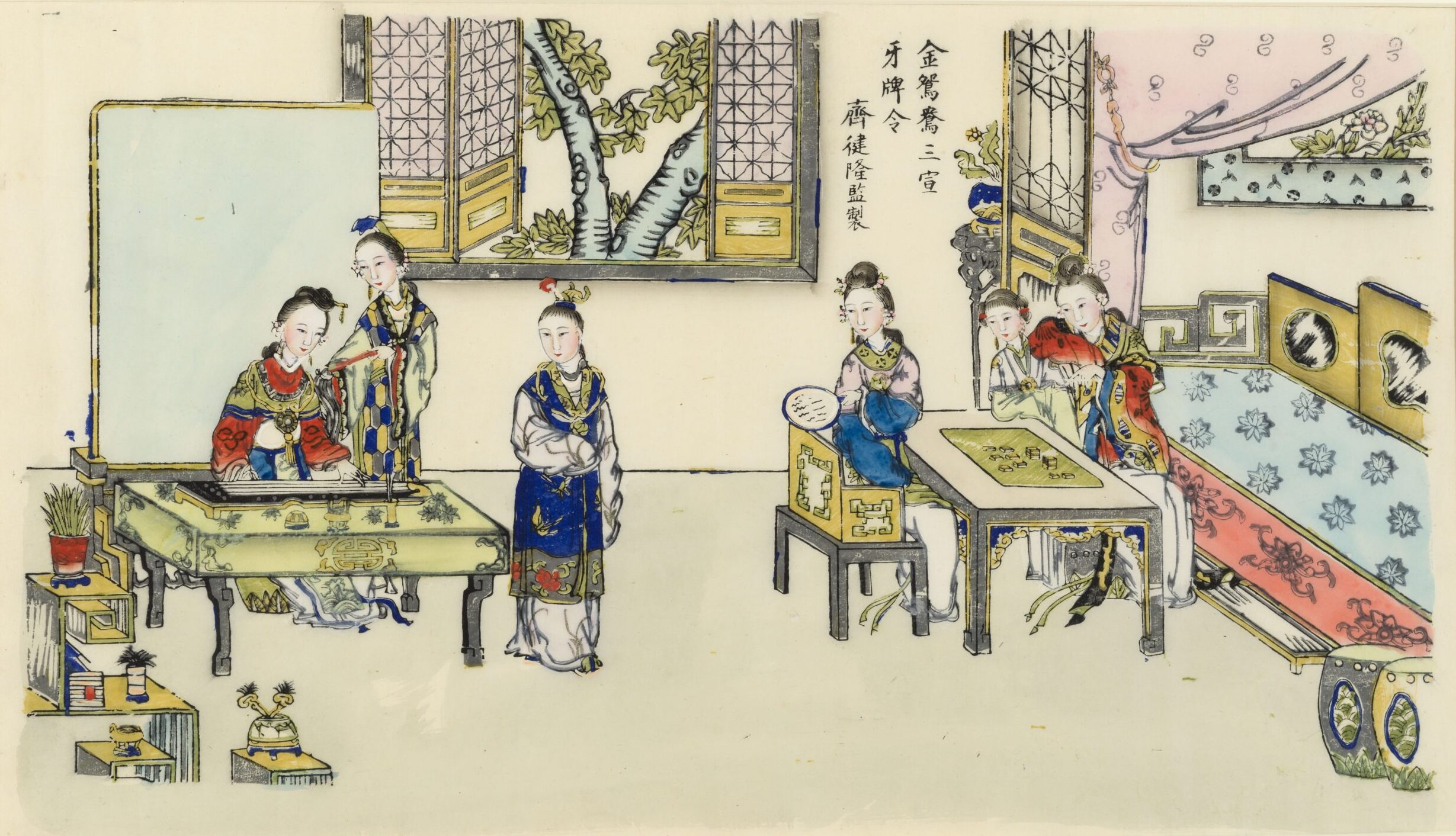
Chinese Ink Painting
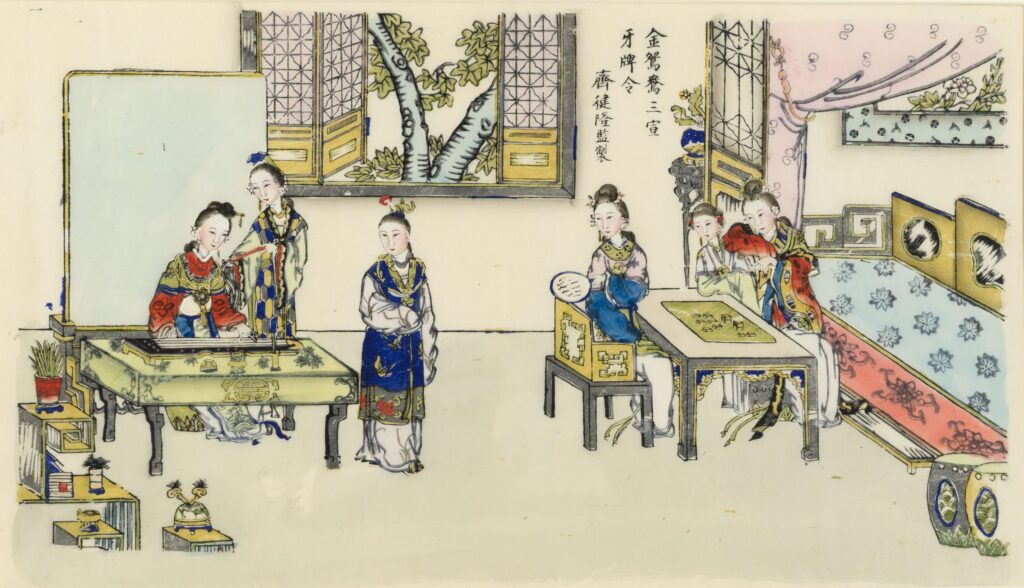
BELUM.C5991
© Image courtesy of National Museums NI
BELUM.C5991: Watercolour painting on rice paper from China
Material: Rice Paper
This watercolour painting on rice paper represents a court scene possibly ‘Poker Game Announced by Jin Yuanyang’ in Chapter 40 of ‘Dream of a Red Chamber’, a famous 18th-century Chinese novel authored by Cao Xueqin. Being able to interpret the painting itself is an intellectual test that educated, elite children in China are expected to be capable of as evidence of showing their awareness of literary masterpieces. The scene’s architectural details—such as open lattice windows, decorated screens, and intricately patterned furnishings—reflect the elite domestic environments typical of late imperial China. The painting depicts elaborately dressed seated women engaged in intellectual pastimes such as playing a stringed instrument, most likely a Guqin, and a game with tiles/tablets, possibly Mahjong or Pai Gow. These ladies are being waited on by domestic servants. The Chinese script at the top of the painting indicates the maker of the painting.
"This painting highlights sharp contrasts between the richly dressed, comfortably seated ladies and the young maids in simpler clothing and deferential postures—one even appearing childlike. These details reveal the social hierarchies and traditional labour expectations placed on poor girls in the past. Reflecting on this alongside my own family history and experiences in Guangdong and Hong Kong, I realise how these patterns persist today: domestic workers, mostly young women and often migrants from lower socio-economic backgrounds, continue to provide essential yet undervalued labour that supports modern households. Although society has changed, inequalities shaped by class, gender, age, ethnicity, and economic status remain deeply embedded, and the painting serves as a reminder that these power structures have evolved but never disappeared."
Sylvia Yue, Project Participant
Bow & Arrows
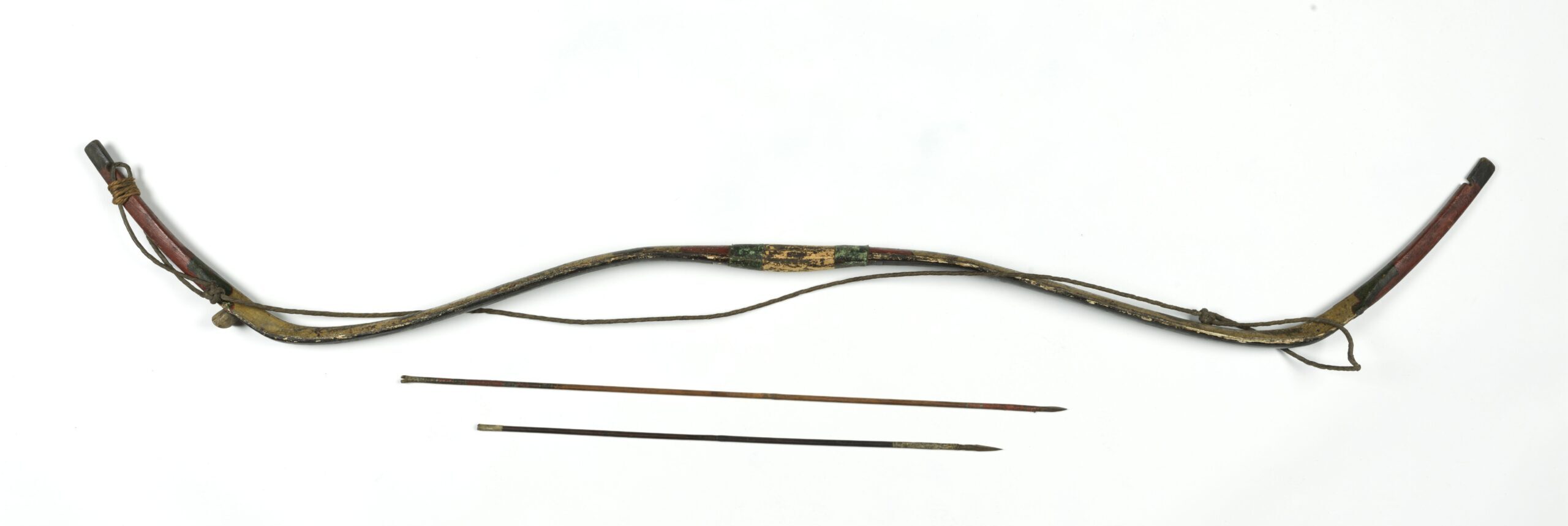
BELUM.C1206.1
© Image courtesy of National Museums NI
BELUM.C1206.1: Traditional Bow & Arrows
Material: Wood | Culture: Chinese | Location: Northern China
Wooden bow covered in painted leather with a string. Decoration includes plant life as well as a swastika well-being symbol. The bow resembles those used by Manchu banner men and the size makes it quite easily identified as a Manchu bow. Bows have been used in Chinese culture for centuries, used for hunting, conflict and symbolically used in folklore stories to tell stories of good and evil.
"By holding this bow, you can understand why the Manchu and other frontier peoples of northern China were such good archers and proficient warriors. This bow is so light to the touch, yet it cannot be broken. It would have made for very durable and agile fighting tactics."
Stephen Lam, Project Participant
BELUM.C1206.2 & .3: Arrows
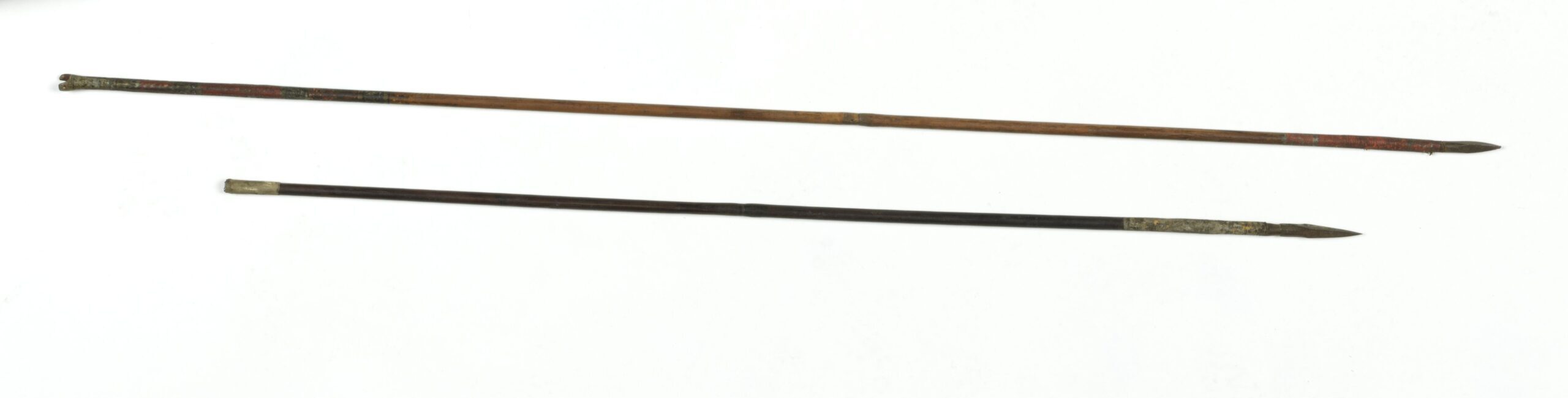
Large (BELUM.C1206.2) and small (BELUM.C1206.3) arrows donated alongside bow. Arrows such as this one were used by Manchu banner men. The arrow is missing the feather used as 'fly'. Arrows were crafted with remarkable precision and varied designs that reflected both technological innovation and tactical needs.
Ivory Chess Pieces
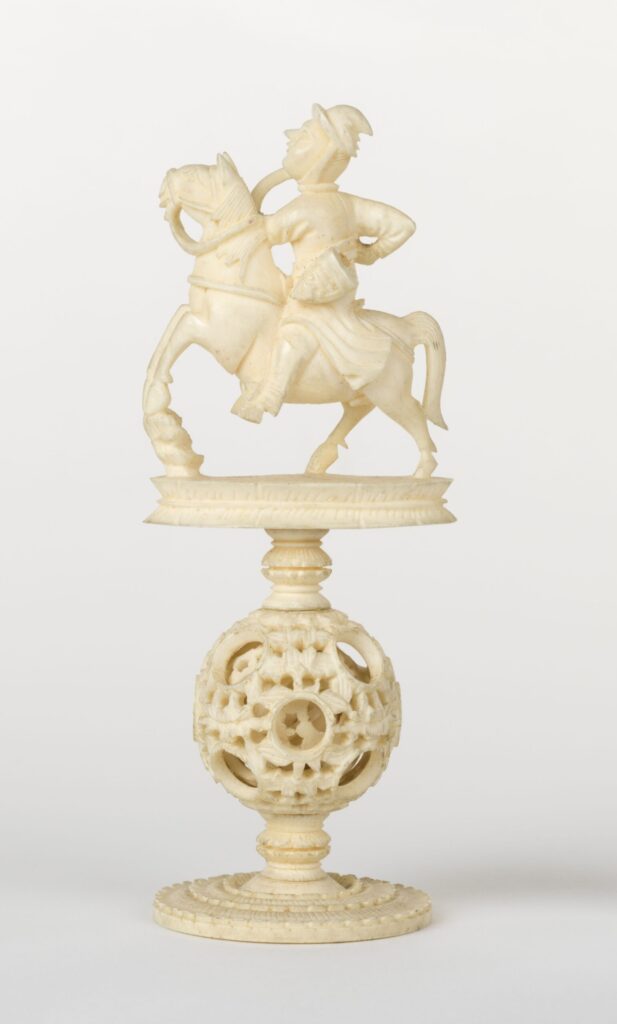
BELUM.C374.1926 & C375.1926
© Image courtesy of National Museums NI
BELUM.C374.1926: Ivory chess piece with globular puzzleball stem
Height: 11.4 cm | Material: Ivory | Culture: Chinese | Location: China
Acquisition method: Purchase | Date of acquisition: 1926
White chess piece features an intricately carved bowman / archer on horseback supported on flat circular lotus carved base with globular puzzle ball stem in ivory. The costume on the bowman may be Mongolian. The piece which can be separated in two, comprises a figure on a base which can be screwed apart from the puzzle ball on a base, essentially allowing for 2 games in one. This is one of two chess pieces purchased by the museum, the other one being BELUM.C375.1926 (below) a stained red chess piece of a cavalryman. Most likely made around 1850 – 1880 in China, Qing dynasty as an export piece for use in Western-style chess. It’s unlikely this piece was made for ‘Chinese chess’ (Xiangqi) which is different to Western-style chess in terms of its characters and rules. Xiangqi was (until the last few years) played almost exclusively with flat discs. In 2018, China banned trade in ivory, including both commercial ivory importation and domestic ivory sales.
“My grandpa taught me how to play Chinese chess. Other adults would let me win or take back my moves, but he never did. Once I moved a piece, I had to live with it. He always said, ‘You can’t always win.’ At the time, I thought he was too strict. Now I understand — it was never just about chess.”
Kelly Wang, Project Participant
BELUM.C375.1926
© Image courtesy of National Museums NI
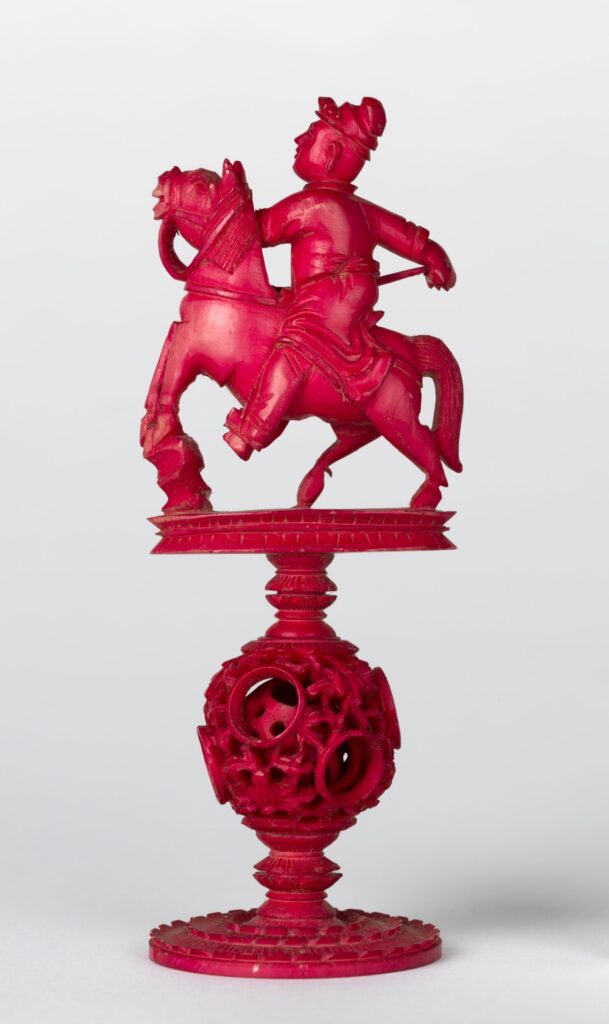
BELUM.C375.1926
Red chess piece features an intricately carved man with a sword on horseback supported on flat circular lotus carved base with globular puzzle ball stem in ivory. The costume on the cavalryman may be Mongolian. The piece which can be separated in two, comprises a figure (with detachable sword) on a base which can be screwed apart from the puzzle ball on a base, essentially allowing for 2 games in one. This is one of two chess pieces, the other one being BELUM.C374.1926 (above), a white ivory chess piece of a knight who is a bowman. Most likely made around 1850 – 1880 in China, Qing dynasty as an export piece for use in Western-style chess. It’s unlikely this piece was made for ‘Chinese chess’ (Xiangqi) which is different to Western-style chess in terms of its characters and rules. Xiangqi was (until the last few years) played almost exclusively with flat discs. In 2018, China banned trade in ivory, including both commercial ivory importation and domestic ivory sales.
Solar-Lunar Compass
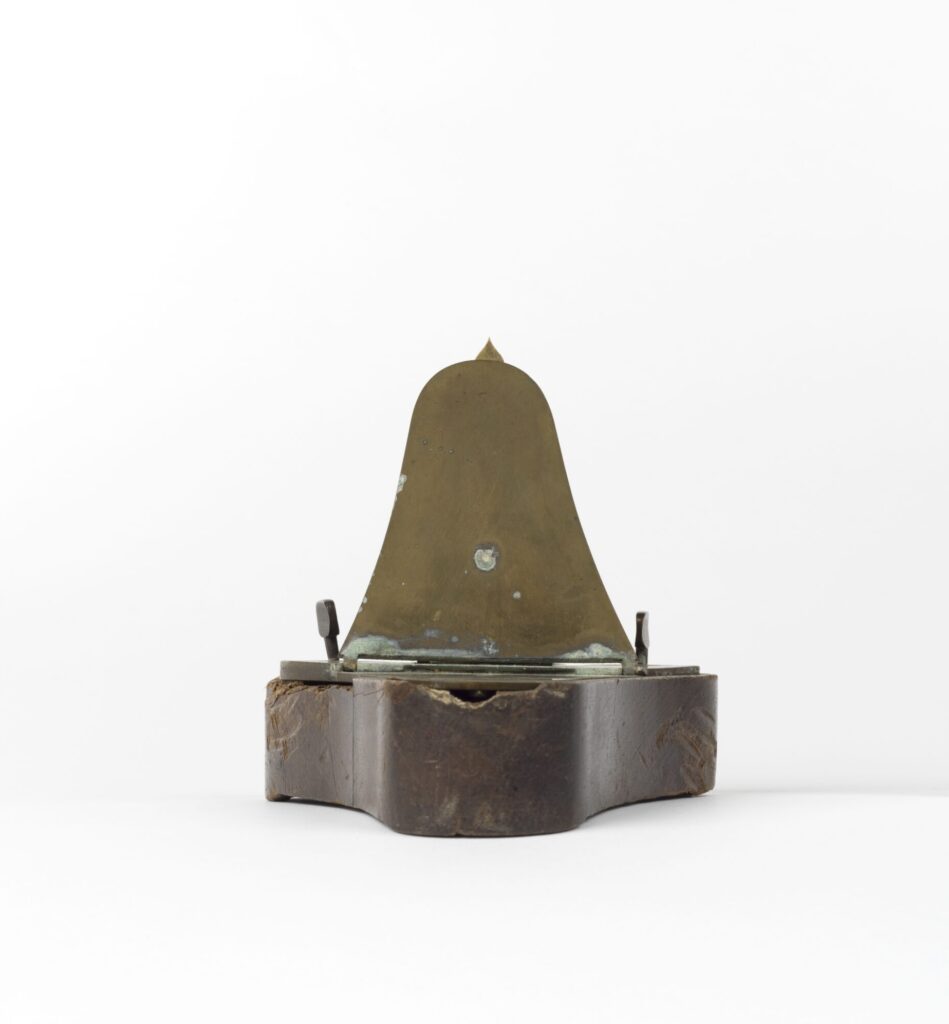
BELUM.C814.1914
© Image courtesy of National Museums NI
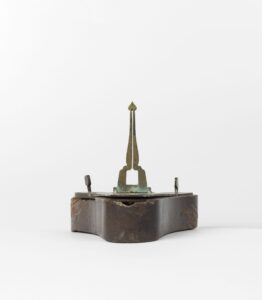
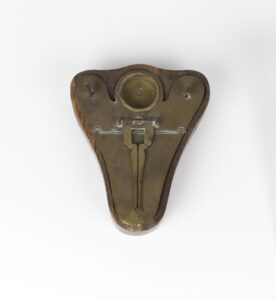
BELUM.C814.1914: Traditional sundial with gnomon
Chinese portable hybrid timekeeping device with sun dial (for reading time by the shadow cast by the sun during the day) and possible water clock (for reading the time made by water drips at night) made of wood and brass with moveable pieces including a gnomon. The upper section represents the day, divided into 12 equal units (2hrs each), named after the twelve earthly branches. The lower section is based on the Chinese solar calendar and uses the 24 solar terms/ cycles to describe seasonal changes. It reflects the ancient Chinese people's profound understanding of the sun's movement patterns. Instruments such as this one were very important to astronomical observation, timekeeping, ritual scheduling, and for work which relied on seasonal change such as farming. Probably Qing dynasty.
"This Chinese equatorial sundial with a 24-solar-term dial wasn’t just for telling the time — it also helped people keep track of the seasons. By combining astronomy, geometry, and careful craftsmanship, ancient Chinese scholars transformed their observations of the sky into practical tools that supported farming and daily life.
Instruments like this show how advanced China was in science and technology at an early stage. Long before similar devices appeared in other parts of the world, they were already being used to measure time accurately and track the 24 solar terms—key to organising farming and community life. They offer a powerful reminder of the depth and ingenuity of traditional Chinese scientific knowledge."
Lili Li, Project Participant
Take the 3D Tour
Imperial Stone Guardians
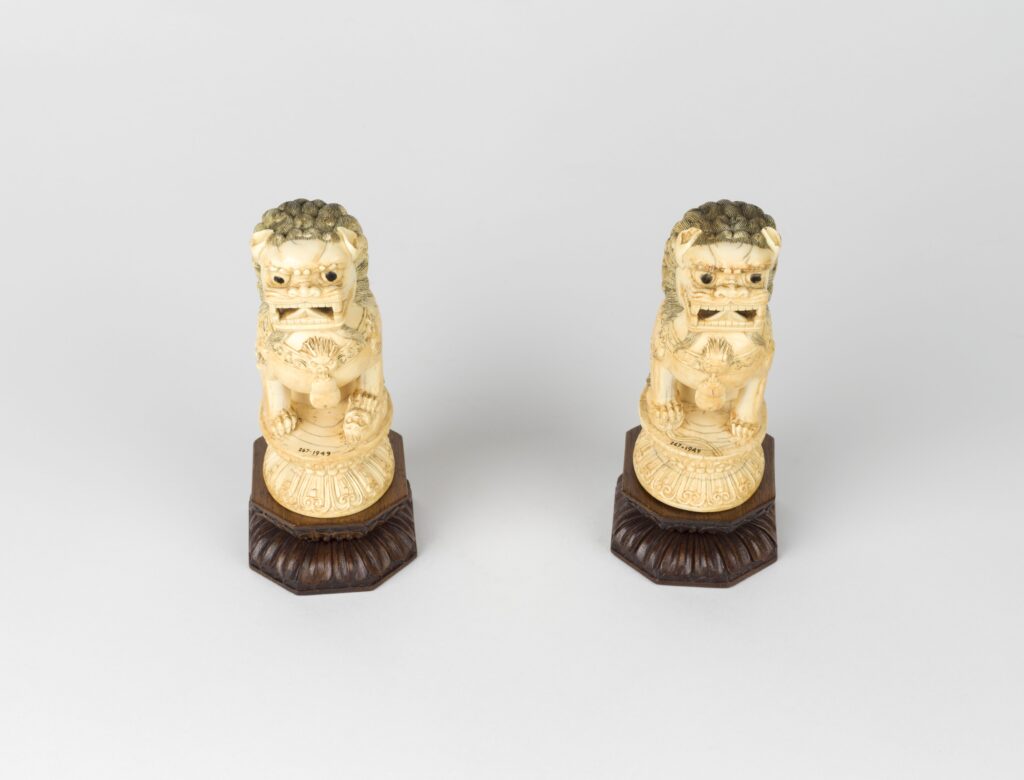
BELUM.C267.1949
© Image courtesy of National Museums NI
BELUM.C267.1949: Lions of Fo - traditional guardian lion dog figures (shi shi)
Material: Ivory | Culture: Chinese
Pair of ivory guardian lions / lions of Fo / lion dogs (shi shi) on wooden lotus bases used to protect from evil spirits. The curly hair on the lions usually depicts a high rank in society. The male lion holds a ball under his paw, symbolising power and authority, representing control over the world and protection of the home or collection it guards. The female lion is portrayed to be cradling a cub under her paw, deemed to be conveying protection, nurturing, and the continuity of lineage. Together, the pair embodies complementary yin-yang principles — the male asserting strength and the female ensuring protection and care. It is typical that the male stands on the right hand side looking at the public while the female stands on his left. Larger examples of Chinese guardian lions are for temple or architectural use, however this small pair was most likely crafted with the intention of a luxury decorative object or presentation gift for the home. Probably late Qing dynasty. In 2018, China banned trade in ivory, including both commercial ivory importation and domestic ivory sales.
Rather than being realistic depictions of lions, shi shi are mythical creatures shaped by artistic exaggeration and symbolism. Their fierce expressions and alert postures emphasise vigilance and strength. As Ri Fang Hao explains:
“The guardian stone lion is a unique creation in Chinese culture that integrates history, art, religion and folklore. Evolving from an exotic rare animal to a divine beast protecting homes and the nation, its image is deeply imprinted in the collective memory of Chinese people.”
Ri Fang Hao, Project Participant
Take the 3D Tour: Male lion and Female Lion
Gilt-Bronze Guanyin
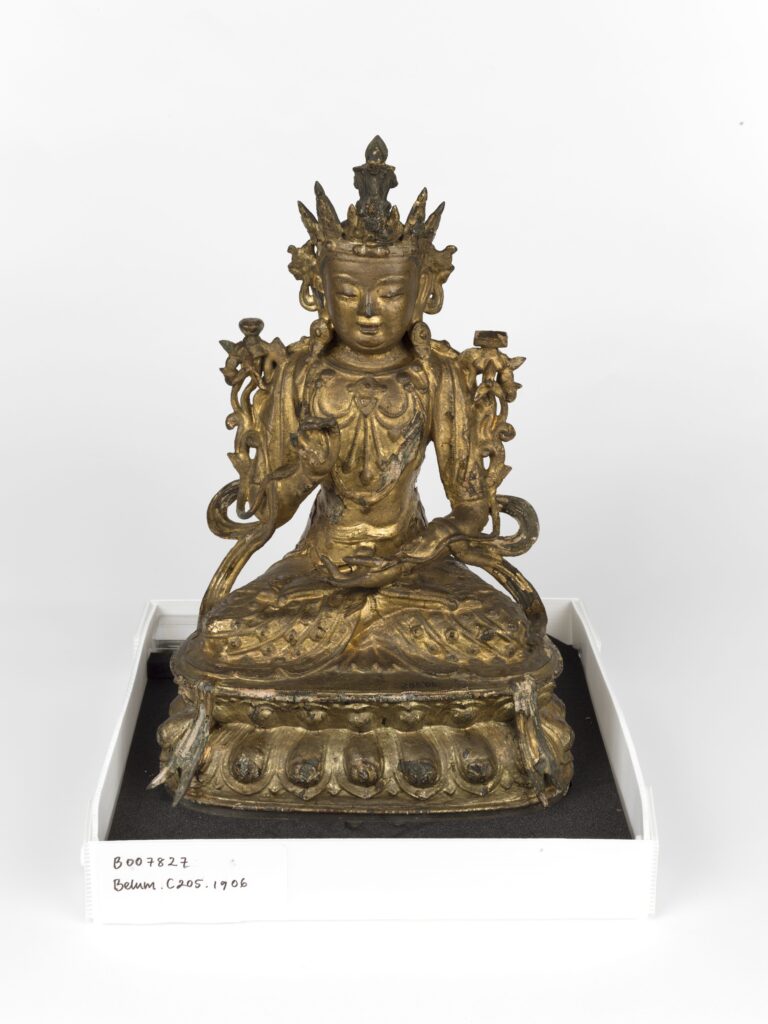
BELUM.C205.1906
© Image courtesy of National Museums NI
BELUM.C205.1906: Buddha in Bronze Gilt
Height: 38 cm | Material: Brass | Culture: Chinese
Gilt bronze figure of Guanyin, the Bodhisattva of compassion, seated on double lotus base in padmasana, crossed legged position. The right hand gesture is called karana mudra and is used to ward off evil, whilst the left hand holds a pearl, symbolising protection and wisdom. Religious figures such as this one are believed to help people through difficult times. Small gilt-bronze figures of this type were produced by lost-wax or sand-mould casting, then gilt and burnished. Late Ming / early Qing.
"My Mum is a Buddhist; This object made me think of her. I grew up focusing on my academics and not paying too much attention to religion. I work as an accountant; I use numbers for a living. There is not much room for interpretation. Still, as I have gotten older and become a mother myself, I value more and more my mother’s input and perspective. It is a helpful guide in an unpredictable world. I feel blessed to have both of these perspectives that carry with them lenses into different eras of Chinese history and, ultimately, different ways to be Chinese.”
Emily Cong, Project Participant
Opium Pipes
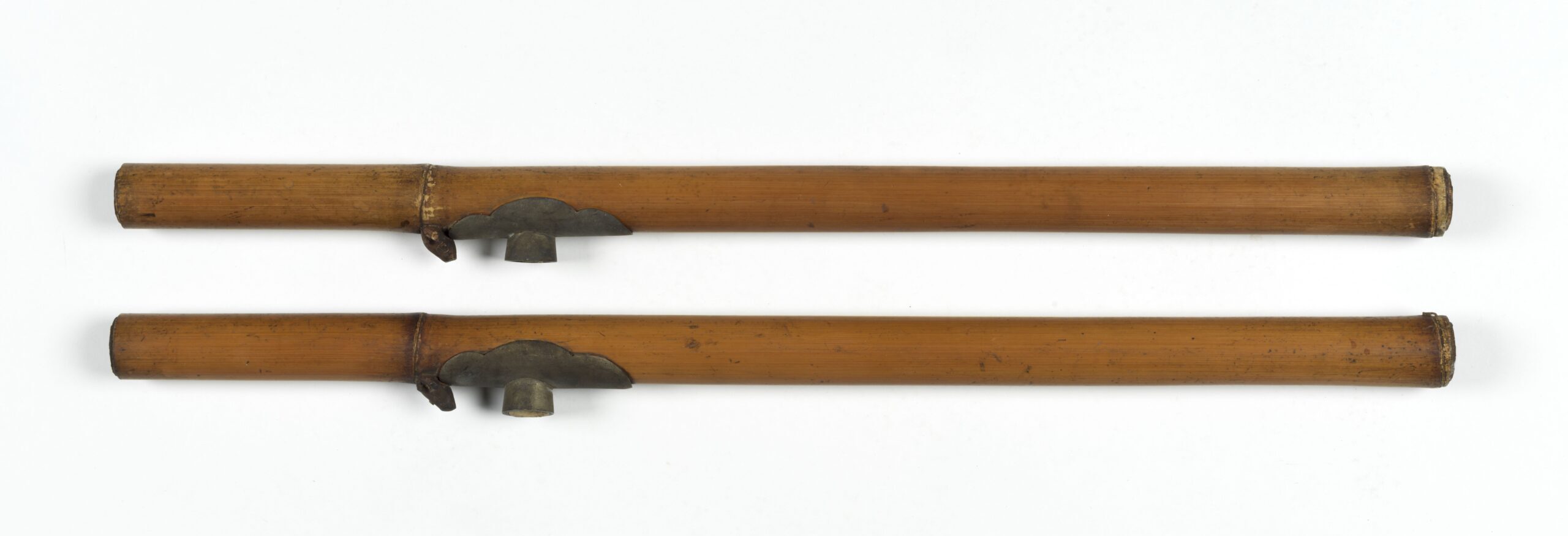
B009759.5
© Image courtesy of National Museums NI
B009759.5: Two Traditional Chinese Opium Pipes
Two large opium pipes. The stem is made from wood, probably bamboo and has a metal saddle. One pipe has a Chinese character inscribed under the metal saddle. Opium had long been valued in China as a medicine that could ease pain, assist sleep and reduce stress. By the mid 19th century however, there were millions of addicts across the country, largely sustained by illegal British imports from India. The Chinese were keen to put a stop to the imports and destroy the stocks of opium. This caused outrage among the British, and was the spark that ignited the Opium Wars during the mid-19th century.
"If you want to see the underlying cause of China's - and indeed much of Asia's - conflicts of the last several centuries, look no further than opium. When used in the right capacity, it has had a profoundly positive effect on modern medicine. But along with that has come many social ills, including addiction, drug trafficking and wars. And unfortunately, these ill effects now span far beyond China's borders. Still, it is a very interesting piece of history that we are better off learning than shying away from."
Stephen Lam, Project Participant
Take the 3D Tour