
BELUM.C374.1926 & C375.1926
© Image courtesy of National Museums NI
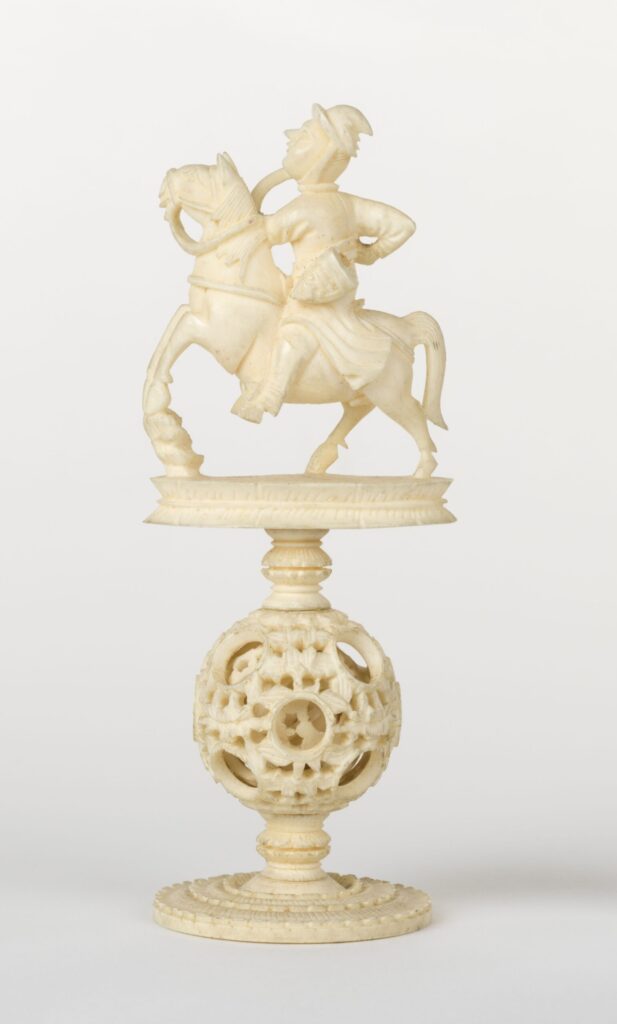
BELUM.C374.1926: Ivory chess piece with globular puzzleball stem
Height: 11.4 cm | Material: Ivory | Culture: Chinese | Location: China
Acquisition method: Purchase | Date of acquisition: 1926
White chess piece features an intricately carved bowman / archer on horseback supported on flat circular lotus carved base with globular puzzle ball stem in ivory. The costume on the bowman may be Mongolian. The piece which can be separated in two, comprises a figure on a base which can be screwed apart from the puzzle ball on a base, essentially allowing for 2 games in one. This is one of two chess pieces purchased by the museum, the other one being BELUM.C375.1926 (below) a stained red chess piece of a cavalryman. Most likely made around 1850 – 1880 in China, Qing dynasty as an export piece for use in Western-style chess. It’s unlikely this piece was made for ‘Chinese chess’ (Xiangqi) which is different to Western-style chess in terms of its characters and rules. Xiangqi was (until the last few years) played almost exclusively with flat discs. In 2018, China banned trade in ivory, including both commercial ivory importation and domestic ivory sales.
“My grandpa taught me how to play Chinese chess. Other adults would let me win or take back my moves, but he never did. Once I moved a piece, I had to live with it. He always said, ‘You can’t always win.’ At the time, I thought he was too strict. Now I understand — it was never just about chess.”
Kelly Wang, Project Participant
BELUM.C375.1926
© Image courtesy of National Museums NI
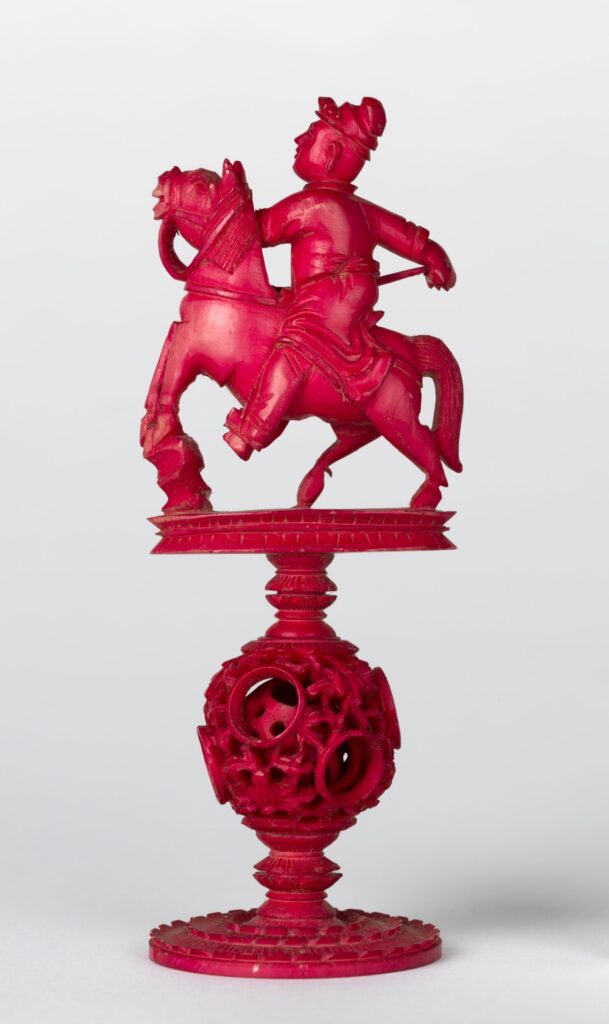
BELUM.C375.1926
Red chess piece features an intricately carved man with a sword on horseback supported on flat circular lotus carved base with globular puzzle ball stem in ivory. The costume on the cavalryman may be Mongolian. The piece which can be separated in two, comprises a figure (with detachable sword) on a base which can be screwed apart from the puzzle ball on a base, essentially allowing for 2 games in one. This is one of two chess pieces, the other one being BELUM.C374.1926 (above), a white ivory chess piece of a knight who is a bowman. Most likely made around 1850 – 1880 in China, Qing dynasty as an export piece for use in Western-style chess. It’s unlikely this piece was made for ‘Chinese chess’ (Xiangqi) which is different to Western-style chess in terms of its characters and rules. Xiangqi was (until the last few years) played almost exclusively with flat discs. In 2018, China banned trade in ivory, including both commercial ivory importation and domestic ivory sales.