
BELUM.C5887
© Image courtesy of National Museums NI
BELUM.C5887: Traditional Chinese Tobacco Pipe
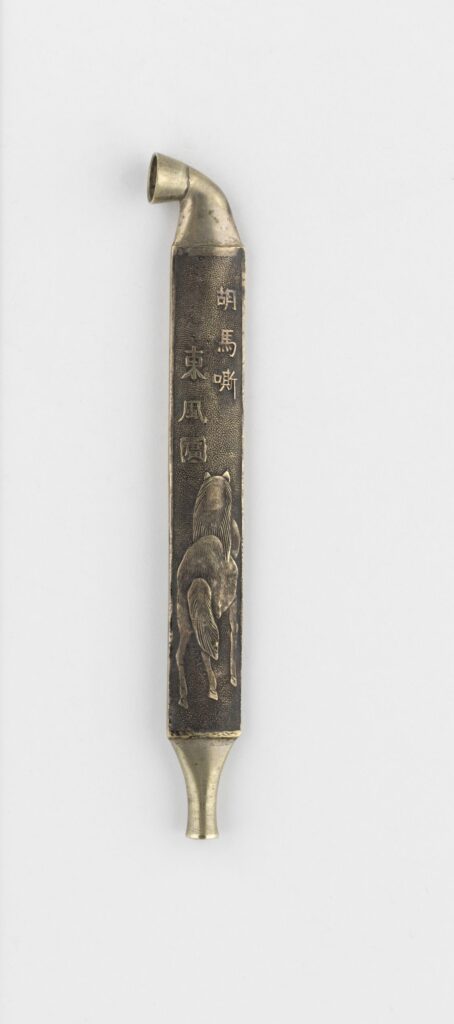
Chinese metal tobacco pipe, referred to as a “horsehead pipe” (馬頭烟嘴/马头烟嘴) due to its distinctive curved end. The Chinese text on the side reads “胡馬嘶東風” (胡马嘶东风), followed by an unidentified sixth character. The text means “The nomadic horse neighs at the east wind”, which is often used as a poetic image of homesickness or longing for one’s native land. The last character has not been identified in any dictionary.
“The structure of the final character resembles the character 廣 (simplified 广, guǎng, meaning “broad,” “wide,” or “vast”) enclosed within 囗 (wéi), which denotes an enclosing border. At first glance, this combination does not appear to relate directly to the meaning of ‘east wind’. However, it is possible that 囗 functions purely as a framing or enclosing element, rather than contributing semantic meaning. In that case, the inner component may represent a name, brand, or maker’s mark, rather than a standard character used for its lexical meaning.”Liang Wang, Queen’s University Belfast
Another possibility is that the unidentified character is an ancient form of 嚝; as 囗 became 口, so the square instead of encircling the rest of the traits is on the left hand side. If this is the case, it means 不錄 “not copied/recorded”.
I feel such a powerful connection to this little ‘horse-head tobacco pipe’. Every word engraved on it seems to speak directly to me. I can almost picture a soldier alone in a remote, frozen wilderness, sitting atop his horse exhaling puffs of smoke into the night — while his heart overflows with an intense longing for home. I have left Hong Kong now for 35 years. I missed my Dad’s funeral – separated from my love ones by thousands of miles, the regrets and ache are something only my own heart could truly feel.Sally Gillespie, Project Participant
Take the 3D Tour